

How does a ship crane structure's rotation mechanism work?
Nov 20, 2025
Hey there! As a supplier of Ship Crane Structure, I've gotten tons of questions about how the rotation mechanism of these ship cranes works. So, I thought I'd break it down in this blog post for all you curious minds out there.
First off, let's talk a bit about what a ship crane structure is. It's a crucial piece of equipment on ships, used for loading and unloading cargo. Our Ship Crane Strucuture is designed to be robust and reliable, handling all sorts of heavy - duty tasks at sea.
Now, onto the rotation mechanism. The rotation mechanism of a ship crane structure is like the heart of the crane's movement. It allows the crane to swing around and reach different areas of the ship or the dock. There are a few key components that make this rotation possible.
The Slewing Ring
One of the most important parts is the slewing ring. It's like a giant bearing that sits between the base of the crane and the rotating upper part. The slewing ring has inner and outer races with a set of rolling elements, usually balls or rollers, in between. These rolling elements reduce friction, allowing the upper part of the crane to rotate smoothly around the base.
Think of it as a giant turntable. When the crane needs to rotate, the power from the drive system is transferred to the slewing ring. The inner race is typically fixed to the base of the crane, while the outer race is attached to the rotating superstructure. As the drive system activates, it causes the outer race to turn relative to the inner race, and voila, the crane starts to rotate.
The Drive System
The drive system is what provides the power to make the rotation happen. There are different types of drive systems used in ship crane rotation mechanisms.
Hydraulic Drive
A hydraulic drive system is quite common. It uses hydraulic fluid to transmit power. Hydraulic motors are connected to the slewing ring. When the hydraulic pump pressurizes the fluid, it flows into the hydraulic motor, causing it to rotate. This rotation is then transferred to the slewing ring, making the crane turn.
The advantage of a hydraulic drive is its high torque output. It can generate a lot of force, which is great for rotating heavy - duty ship cranes. Also, hydraulic systems are relatively compact and can be easily controlled. You can adjust the speed and direction of rotation just by controlling the flow of hydraulic fluid.
Electric Drive
Electric drive systems are also popular. They use electric motors to power the rotation. Electric motors are connected to the slewing ring through a gearbox. The electric motor rotates at a high speed, and the gearbox reduces this speed while increasing the torque.
Electric drives are known for their efficiency and precision. They can be easily controlled using electronic controllers. You can program the crane to rotate at a specific speed or to a certain angle. Plus, electric drives are more environmentally friendly compared to some other power sources, as they don't produce emissions.
Control Systems
To ensure safe and accurate rotation, ship cranes are equipped with sophisticated control systems. These control systems allow the operator to control the speed, direction, and angle of rotation.
There are usually joysticks or control panels in the crane's operator cabin. The operator can use these controls to send signals to the drive system. For example, if the operator wants the crane to rotate clockwise, they simply move the joystick in the appropriate direction. The control system then interprets this signal and adjusts the power supply to the drive system accordingly.
Some modern ship cranes also have automated control features. They can be programmed to rotate to specific positions based on pre - set coordinates. This is especially useful in repetitive loading and unloading operations, as it reduces the chances of human error.
Safety Features
Safety is always a top priority when it comes to ship crane operation. The rotation mechanism is no exception. There are several safety features built into the system.
Limit Switches
Limit switches are used to prevent the crane from rotating beyond its safe limits. These switches are placed at the end - points of the crane's rotation range. When the crane reaches these points, the limit switch is activated, and it sends a signal to the control system to stop the rotation.
Braking Systems
Braking systems are also essential. They are used to stop the rotation of the crane quickly in case of an emergency. Hydraulic or electric brakes can be applied to the slewing ring or the drive system. When the operator presses the emergency stop button, the brakes are engaged, bringing the crane to a halt.
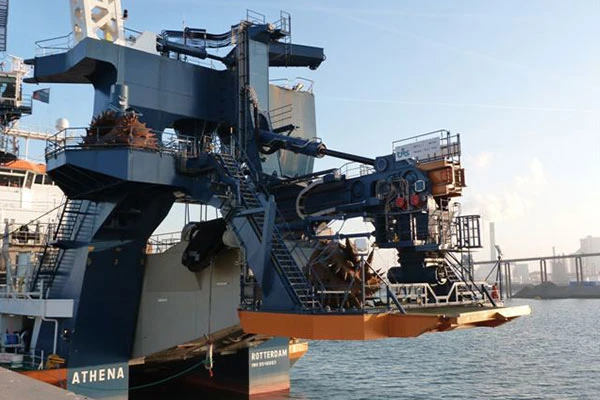

Applications and Advantages
Ship crane rotation mechanisms have a wide range of applications. They are used in various types of ships, from cargo vessels to offshore platforms.
On cargo ships, the ability to rotate the crane allows for efficient loading and unloading of containers and other types of cargo. The crane can swing around to different parts of the ship or the dock, reaching all the cargo storage areas.
In offshore applications, ship cranes are used for tasks like installing and maintaining equipment on oil rigs. The rotation mechanism enables the crane to position heavy equipment precisely at the required location.
The advantages of a well - designed rotation mechanism are numerous. It increases the flexibility of the crane, allowing it to access different areas without having to move the entire ship. This saves time and effort during loading and unloading operations. Also, the precise control of rotation ensures that cargo can be handled safely and accurately.
If you're involved in the marine or offshore industry, you might also be interested in our other products, such as Self - unloader Structure and Offshore Steel Structure. These products are also designed with high - quality materials and advanced engineering to meet the demanding requirements of the industry.
If you're in the market for a reliable Ship Crane Structure or have any questions about how our rotation mechanisms work, don't hesitate to reach out. We're always here to help you find the best solution for your needs. Whether you need a crane for a small coastal vessel or a large - scale offshore project, we've got you covered.
References
- Smith, J. (2018). Marine Crane Technology. Maritime Press.
- Johnson, R. (2019). Handbook of Offshore Equipment. Engineering Publishers.
- Brown, A. (2020). Hydraulic and Electric Drive Systems in Heavy Machinery. Industrial Press.